Blog

Intersecting Interests

I find myself without a particular topic in mind for a post this week, so I thought I’d share a little (read: enormous) project I’ve been working on since the start of the semester.

Brief preface: the main project of one of my courses is aimed at helping us to develop our research interests. Over the course of the 15 weeks of the semester, we’re gathering and annotating scholarly articles, conducting a historical overview of how our topics have been studied over the last 25 years, and documenting important scholars, journals, and associations in our fields. From what I can tell, most of my classmates are keeping track of this stuff through lists, folders, and spreadsheets — all totally normal and sensible organizational tools. But I’m weird. And I like math, and colors, and things I can drag around on screens. So, I took a little bit of a different approach to organizing my project information.

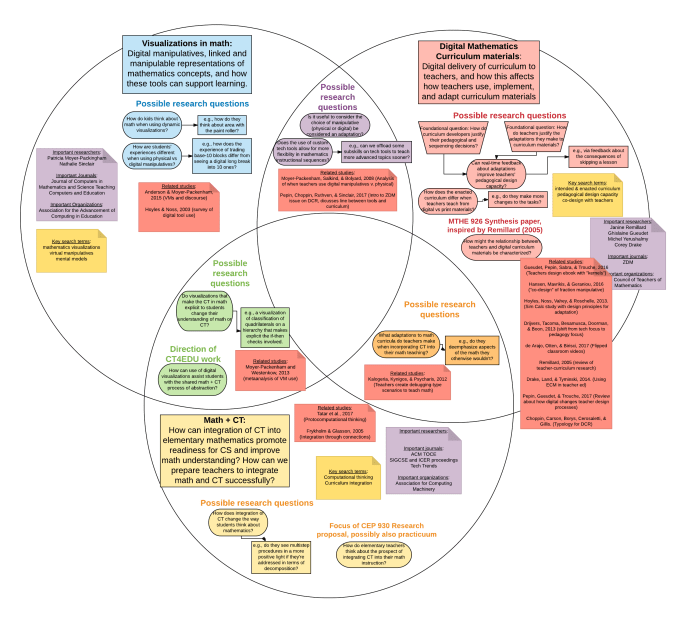
I present to you: my Venn diagram of research interests! (OK, so you already saw it above. That was the easiest way for me to make it big enough to see. But now you know what it is.)

The circle with the blue box and bubbles represents my first big area of interest: dynamic visualizations in math. In that circle live a lot of questions about the use of draggable interactives in mathematics, like digital versions of manipulatives and smart graphs that, for example, retain certain properties as you drag them. How does the use of stuff like this change the way kids think about math? How do we best leverage its potential? When are the times where it’s best to just put the tech away?

The circle with the red box and bubbles represents my second big area of interest: digital curriculum materials and how teachers interact with them. In that circle live questions about how digital materials can best support teachers in designing instruction for their specific contexts. How might feedback on instructional design decisions help teachers develop pedagogical design capacity?


The circle with the yellow box and bubbles represents my third big area of interest: the relationship between computational thinking (CT) — in brief, the thinking practices used by computer scientists, like abstraction, conditional relationships, and pattern recognition — and elementary mathematics. There’s a current push to bring computer science education to all kids in K-12, and when it comes to elementary school, I think integration of some CT ideas into mathematics is a great place to start. But what does math+CT instruction look like? How do teachers implement it? What is similar in mathematical thinking and computational thinking, and what’s different? When are those similarities and differences important?

The most interest part about exploring literature related to these topics has been discovering the ways in which they interrelate. One of the benefits of using digital manipulatives, for example, is that they seem to help kids abstract mathematical concepts (Moyer-Packenham & Westenskow, 2013) — and abstraction is a CT practice! That is what is living in the green section. Digital manipulatives (blue) + math and CT (yellow) = abstraction (green). The same research team who noted the connection between digital manipulatives and abstraction also did a study of how and when teachers choose to use digital manipulatives (Moyer-Packenham, Salkind, & Bolyard, 2008), and this study got me thinking about how the choice to use a digital manipulative is a critical part of the instructional choices teachers make when enacting curriculum. That is what’s living in the purple section. Teacher design decisions (red) + digital manipulatives (blue) = digital manipulatives as part of instructional design (purple). Last but not least, I recently read a study looking at how teachers use and adapt simple debugging tasks as part of their mathematics teaching (Kalogeria, Kynigos, & Psycharis, 2012). The tasks were not framed as debugging tasks by the researchers, but I definitely think they could be framed that way. So, that’s the orange section. Debugging tasks (yellow) + teacher design decisions (red) = how teachers use debugging tasks (orange).

As my advisors have told me many times already, I can’t expect to explore all of these questions in the four years I am in graduate school. But if I do end up in a research position later, these are the interconnected ideas that I hope will drive my program of research. If any of my faithful readers have recommendations for readings related to such things, I’d be glad to hear them.

To end, a fun exercise: What do you think goes in the center of the diagram?

References

Kalogeria, E., Kynigos, C., & Psycharis, G. (2012). Teachers’ designs with the use of digital tools as a means of redefining their relationship with the mathematics curriculum. Teaching Mathematics and its Applications, 31(1), 31-40.

Moyer-Packenham, P., Salkind, G., & Bolyard, J. (2008). Virtual Manipulatives Used by Teachers for Mathematics Instruction: Considering Mathematical, Cognitive, and Pedagogical Fidelity. Contemporary Issues in Technology and Teacher Education, 8(3), 202-218.

Moyer-Packenham, P., & Westenskow, A. (2013). Effects of Virtual Manipulatives on Student Achievement and Mathematics Learning. International Journal of Virtual and Personal Learning Environments, 4(3), 35-50.


A Painful Truth

I was in middle school when the musical RENT was big. My friends and I were obsessed. We wanted to be just like Mark and Roger, living the Bohemian life of sacrifice for art in New York City. We stood in hours-long lines to get rush tickets, sang the soundtrack at the back of the bus, adopted No Day But Today as a motto, and swore we’d never sell out by working for the man. RENT was everything. RENT was life.

Gradually RENT fell out of my day-to-day existence, but even into adulthood it still held a special place in my heart. That’s why it was so painful when I read this article a few years ago. In short, the article points out that RENT looks quite different from the point of view of a working adult. The sell-out character, Benny, isn’t the villain our middle-school selves believed him to be. He’s a hero who tried desperately to save his friends from themselves.

Oh man, that hurts, I thought. It hurts because it’s so, so true.

The hard thing about reading the article wasn’t its scathing tone. It was the way it completely destroyed something I believed in for a long time. And did it in a way I couldn’t refute. Oh, it hurt. It really hurt.

I had a similar experience this week when reading a book chapter about equity in mathematics education. In a critique of the common rhetoric used to discuss equity, Alexandre Pais (2012) calmly and completely deconstructed the claim that students need to learn mathematics to be functioning citizens: “Mathematics is posited as indispensable knowledge and competence to participate in the world – the idea that through mathematics we become empowered citizens” (p. 63). But the idea that students must use mathematics in their daily lives, he said, is a lie we construct to conceal an ugly truth: “It is not that school mathematics is powerful because people use it in their daily lives; mathematics is powerful because it gives people school and professional credit” (p. 65).

Oh man, I thought. That hurts. That hurts because it’s so, so true.

When I read that sentence I had to close my eyes and pause for a minute before I went on reading. It really felt like a gut punch. Since that moment, I’ve been trying to sort out why it made me feel that way. Here is what I’ve been able to figure out.

First, I have been struggling with the idea of mathematical utility in everyday life for a long time. After years and years of writing word problems designed to help kids practice particular mathematical skills, I became thoroughly disenchanted with the process of working from mathematics to context. Most of the time that just produces contrived problems. For a while I was focused on working in the opposite direction — starting with contexts and writing problems that used mathematics to solve related problems. This was a fun project, and interesting, but also difficult. The truth is, there are limited professional and everyday contexts that use mathematics in a meaningful way — at least when the mathematics under consideration is the mathematics typically taught in schools.

So it wasn’t the first half of Pais’s (2012) statement that hurt. I had already come to the same conclusion on my own; I knew that school mathematics wasn’t all that useful in everyday life. But I made peace with that part by insisting that there were other benefits to learning mathematics. I traced ways that my math training has helped me to think more critically about problems and to cut through the noise to get to the heart of matters. Surely other students reaped the same benefits. Plus, I thought, math is just interesting and beautiful. Not every student is going to feel that way, but every kid should get the chance to discover whether they do. Right? There are reasons for learning school mathematics.

This is why I reacted as I did to Pais (2012). That strongly held belief was shot down by the second half of Pais’s statement. Sure, there is a reason to learn mathematics. But it isn’t any of the beautifully crafted reasons I held dear. It’s because facility and achievement with mathematics earns students “school and professional credit” (Pais, p. 65).

The reason kids need to learn mathematics is because it earns them credit in the system. Not because of all the lovely reasons I had constructed in my head.

Ouch, I thought. It hurts because it’s true.

My first defense mechanism was to think that just because this was the reason kids had to learn school mathematics didn’t mean it was the only reason they should. But I kept going back to the main point of Pais’s (2012) essay, which was the falseness of the narrative of about “mathematics for all.” Schools cannot claim to treat “mathematics for all” as their goal when the whole system depends on some students passing and some failing. As long as we keep pushing “mathematics for all,” school mathematics will remain a gatekeeper in education. In that sense, should is not any better than must as a preface for a reason to learn mathematics.

Ouch again.

Pais (2012) acknowledges that his points in some sense lead to a deadlock. What should we do? Just stop teaching math instead of trying to improve mathematics education? Put an end to schooling altogether? The sensible first act, Pais says, might be to stop acting. The best thing might just be to stop and think. I did some of that, and here are a few things I have to say.

One of the goals of my professional life to this point has been to help make mathematics education more meaningful for kids. Recently I’ve talked about how I think meaning can be achieved not through connectedness to everyday life but through connectedness internal to mathematics — by highlighting big ideas in mathematics. This line of thinking is not really in conflict with Pais’s (2012) point. This line of my work doesn’t claim that mathematics is good for anything but learning more mathematics. So as long as schools still exist and mathematics is taught, I don’t think I’m doing harm by trying to make it more meaningful.

A big part of my motivation for this work, though, is that I am deeply bothered by how common it is for people, children and adults alike, to proclaim that they are “not math people.” I want everyone to feel like a math person. Until today I held strongly to the belief that the reason most people say “I’m not a math person” is because they were never taught math in a meaningful way. Pais’s (2012) essay has forced me to admit that there is much more to it than that. Yes, in many cases, the idea that one is “not a math person” likely comes from poor experiences in mathematics classes. And yes, I still think the “not a math person” is a societal narrative worthy of change. But I think it’s important for me to recognize that “not a math person” might mean “not a school math person,” and to insist that all students should love and appreciate school mathematics is something that will only perpetuate inequity.

It hurts. But it’s true.

Reference

Pais, A. (2012). A Critical Approach to Equity. In O. Skovsmose & B. Greer (Eds.). Opening the Cage: Critique and Politics of Mathematics Education (pp. 49-86). Rotterdam, Netherlands: Sense Publishers.

Realizing the Register

For several years, starting shortly after the release of the Common Core State Standards for Mathematics (CCSS-M; Common Core State Standards Initiative [CCSSI], 2010), I spent every day of my working life designing, writing, testing, and editing activities meant to address the K-5 content standards. Often, this work was fun. There were a handful of standards, however, that tended to make the work miserable.

Take this fifth-grade standard from the Operations and Algebraic Thinking strand (5.OA.2):

Write simple expressions that record calculations with numbers, and interpret numerical expressions without evaluating them. For example, express the calculation “add 8 and 7, then multiply by 2” as 2 × (8 + 7). Recognize that 3 × (18932 + 921) is three times as large as 18932 + 921, without having to calculate the indicated sum or product. (CCSSI, 2010, p. 35)

True confessions: I came to hate this standard. At first read, it doesn’t seem so bad. However, attempting to develop extended activities on it — a full lesson, and plenty of follow up practice — was a slog. I (and all the members of the team working on this grade level’s materials, from what I remember) quickly ran out of ways to make this work interesting. Grouping symbols were new to the grade level, but the translation and interpretation of expressions from words to symbols was not. The standards in first through fourth grades required students to write equations to represent word problems, a task related to this standard but more interesting because the translation in those cases required more abstraction. Story-to-symbols can be interesting; words-without-context-to-symbols seemed to be a step backward. I just couldn’t understand the point of this standard. Any time I wrote another prompt for students to write about how, for example, (5 + 7) × 2 was twice (5 + 7), I said a silent apology to the future fifth graders of America.

A few weeks ago, though, I read some articles that made me think a bit differently about this standard. The articles focused on the mathematics register, or “meanings that belong to the language of mathematics (the mathematical use of natural language, that is: not mathematics itself), and that a language must express if it is being used for mathematical purposes” (Halliday, 1978, p. 195). The math register does not consist only of vocabulary, but also of language structures and modes of argument that convey meaning (Halliday). The notion of the math register has been discussed and expanded in various ways since Halliday introduced it. Of particular interest to me is the idea that the mathematics register includes symbolic notations and grammatical structures that map onto each other in opaque ways; for example, one way to translate a2 + (a + 2)2 = 340 into spoken or written language is, “The sum of the squares of two consecutive positive even integers is 340” (Schleppegrell, 2007, p. 145).

As I read the Schleppegrell piece, I was struck by the illustration of how complex the translation from mathematical symbols to words and back can be. I thought again about 5.OA.2. The examples given in the standard are trivial (after the first few practice rounds, at least), but in general, there are plenty of examples that are not, particularly when variables start to be used to express general relationships. The text of 5.OA.2 does not allow for the use of algebraic, rather than numeric, expressions, but suddenly I wondered if this standard was intended to support readiness for more complex sorts of translation and interpretation of expressions later.

Based on the information I have at hand, my best answer to that question is “maybe.” According to the draft progression document for the Operations and Algebraic Thinking (OA) strand of the CCSS-M, the intention of 5.OA.2 is to prepare students to work with algebraic expressions in later grades: “[S]tudents in Grade 5 begin to think about numerical expressions in ways that prefigure their later work with variable expressions (e.g., three times an unknown length is 3 × L)” (Common Core Standards Writing Team, 2011, p. 32). They go on to further describe the work in Grade 6:

In Grade 6, students will begin to view expressions not just as calculation recipes but as entities in their own right, which can be described in terms of their parts. For example, students see 8 × (5 + 2) as the product of 8 with the sum 5 + 2. In particular, students must use the conventions for order of operations to interpret expressions, not just to evaluate them. Viewing expressions as entities created from component parts is essential for seeing the structure of expressions in later grades and using structure to reason about expressions and functions. (Common Core Standards Writing Team, 2011, p. 34)

It seems clear that the standards writers were attempting to anticipate an increase in complexity in interpretation of expressions. I’m not entirely convinced they were focused on the communication of meanings as Schleppegrell (2007) was; rather, they seem to be focused specifically on recognizing mathematical structures and reasoning about them, rather than ascribing them with meaning in natural language. Still, there’s some evidence of an intention behind standard 5.OA.2 that I didn’t understand until I read about the mathematics register.

I spent countless hours thinking about 5.OA.2 and many of the other standards. I have thought about them together and separately; as activities in their own right and as learning goals for those activities; in their most literal and most figurative senses. I did not think there were many more ways to think about or interpret them than those I’d already turned over in my head at least once. But this experience proved me wrong. Now I have new way to think about why this standard might matter to students’ understanding of mathematics.

I’m not sure how this new information would affect my curriculum development work if I had a time machine and could go back and try again. Maybe it wouldn’t change anything about the practical implementation or the student exercises. But I suspect it would change the way I wrote about it in the teacher materials.

What do you think? Is building readiness for interpretation of algebraic expressions a worthwhile goal? Is it what 5.OA.2 was meant to do?

References

Common Core State Standards Initiative (CCSSI). (2010). Common Core State Standards for Mathematics. Retrieved 06 October 2017 from http://www.corestandards.org/Math/.

Common Core Standards Writing Team. (2011). Progressions for the Common Core State Standards in Mathematics (draft): K, Counting and Cardinality; K-5, Operations and Algebraic Thinking. Retrieved 06 October 2017 from https://commoncoretools.files.wordpress.com/2011/05/ccss_progression_cc_oa_k5_2011_05_302.pdf

Halliday, M. A. K. (1978). Sociolinguistic Aspects of Mathematical Education. In Language as Social Semiotic: The Social Interpretation of Language and Meaning (pp. 194-204). Baltimore, MD: University Park Press.

Schleppegrell, M. (2007). The linguistic challenges of mathematics teaching and learning: A research review. Reading and Writing Quarterly, 23(2), 139-159.

More on Mattering

One of the most interesting and useful effects of keeping a blog or journal, I find, is that once I take the time to develop and articulate an idea, I start seeing it everywhere. Such is the case with my Big M, little m post from early this month. Because so many readers expressed interest and enthusiasm for the idea of making learning matter, I wanted to share a few resources I’ve collected about that since my original post.

First, on mattering from a research and instructional design perspective:

A reading in one of my courses pointed me to a pedagogical standard called the necessity principle, which states that content should be presented to students in a way that establishes an intellectual need for it (Harel & Tall, 1991). This, in turn, reminded me of a favorite article of mine that describes a framework for learning task design. The two design principles in the framework are purpose, stating that tasks should feel purposeful from the students’ perspective, and utility, stating that task should establish why the mathematics involved is useful (Ainley, Pratt, & Hansen, 2006). Necessity, purpose, and utility all feel intimately connected to the question, Why does it matter? I’ll include the full references at the end of this post in case anyone is interested in reading more. Interestingly, although the principle and framework from the articles have been used in some later research, they haven’t been used as much as I expected given that the ideas resonate so strongly with me. Perhaps I have found an interesting niche where there is room for a new scholar such as myself to make a contribution.

Next, mattering from a practitioner perspective:

My original Big M, little m post focused on how attention to why big ideas matter could make for a more connected and coherent school experience for students. As I reflected further on this issue, however, I realized that mattering has also been discussed at some length in relation to engagement. In particular, I was reminded of prolific mathematics education blogger Dan Meyer’s recurring theme of creating headaches for students for which mathematics is the aspirin. I first heard him speak about this at the Ontario Association of Mathematics Educators conference in 2015 and for a time followed his blog post related to this theme. I have since not followed it as closely for a variety of reasons — one in particular being my interest in elementary education and his focus on secondary education. Still, he gives some wonderful examples that the partitioners reading this might find useful and interesting. Give that Dan Meyer is now the Chief Academic Officer at Desmos, I may start following his work again to see how he uses technology to create new kinds of (productive!) headaches for kids.

Lastly, on mattering from a writer’s perspective:

One of the aspects of my coursework that I’m finding particularly valuable is my professors’ dual attention to helping us find footing in the academic literature and to helping us become better academic writers. In the reference list below, I’m including two books I’ve been reading, at the suggestion of professors, that each include super useful frameworks for structuring writing and research in ways that will convince your readers that your ideas matter. Graff and Birkenstein (2010) advocate consistently asking yourself, “So what? Who cares?” about your own and other writers’ points. It is rather annoying to continually have to articulate an answer to this, but it is an excellent exercise in making sure you get to a point that someone other than you will care about. Booth and colleagues (2016) provide a more structured way to get to the point, for when self-queries of “So what? Who cares?” come up empty. They suggest filling in three blanks: I am studying [blank] because I want to [blank] so that [blank].  For example:

I am studying how technology impacts mathematics teaching and learning because I want to understand how technology can be used to make mathematics engaging and meaningful for students so that fewer students leave school believing that mathematics is useless, meaningless, or, worst of all, not for them. Often, when I get bogged down in the small details of my research or writing, I lose track of the big picture. The third blank in Booth and colleagues’ framework is useful for remembering why I do this work.

I hope you find these resources useful! If you have more that you’d like to pass along, feel free to tell me in the comments!

References

Ainley, J., Pratt, D., & Hansen, A. (2006). Connecting engagement and focus in pedagogic task design. British Educational Research Journal, 32(1), 23-38.

Booth, W. C., Colomb, G. G., Williams, J. M., Bizup, J., & Fitzgerald, W.P. (2016). The Craft of Research, 4th edition. Chicago: University of Chicago Press.

Graff, G., & Birkenstein, C. (2010). They say, I say: Moves that matter in academic writing, 2nd Edition. New York: W.W. Norton & Company.

Harel, G., & Tall, D. (1991). The general, the abstract, and the generic in advanced mathematics. For the learning of mathematics, 11(1), 38-42.

Opening Curriculum

A few weeks ago, I wrote about my quest to understand the essential features of curriculum, with the hope of eventually creating a framework for the design of digital curriculum materials that both allow for teachers to make adaptations to their contexts and maintain curriculum coherence. In the many years I’ve been thinking about how to design flexible curricula, I have always approached it from this angle: Figure out the essence of the current version of a curriculum (in my head, this is generally a textbook, although I acknowledge there are other forms), and build those essential features into a digital platform.

One of my projects for this first semester of graduate school is a targeted effort to understand and better articulate my research interests, and so I’ve spent some time thinking about why this question and this particular approach is of such interest to me.

My interest in the question is easy to trace. Over the years of my career as a developer of textbooks, increasing numbers of schools and districts have begun abandoning textbooks as a source of curriculum in favor of putting together their own collections Open Educational Resources (OERs) (Gueudet, Pepin, Sabra, & Trouche, 2016; Ruthven, 2016). Although I recognize that there are likely a set of complex interconnected reasons for this trend, I believe that one of them is the lack of adaptability of traditional printed curricula. Static delivery simply isn’t meeting teachers’ needs, so I want to figure out how to design something that will.

The reasons I’m drawn to the first step of my general approach, figuring out a curriculum’s essential features, probably stem from a number of things. First, there’s the mathematician in me who loves to strip things down to their essence. There is also a pragmatic appeal to this step. This problem is one of navigating the tension between some things needing to change and some things needing to stay put. It just makes sense to me to start by figuring out which is which. Finally, there’s the level of personal intrigue in this question. Despite being a curriculum developer for ten years, I don’t think I can articulate the essential features of the programs I worked on. This question is thus a sort of personalized puzzle for me. (And I love puzzles!)

I can explain the rationale for designing flexible curricula and the reasons for attention to essential features, then. What I’ve been having more of a problem with is explaining the final piece: why I think delivery of curriculum through digital means is the way to go.

I did come up with a few reasons. The industry is going digital, so we should figure out the best ways to take advantage of that. Digital versions allow for easier updates. And so on. But I wasn’t satisfied. None of these seemed to justify the use of digital platforms for this purpose specifically. Why is technology important to the issue of helping teachers made adaptations to curriculum? Why not instead focus on finding better ways to communicate the essential features to teachers directly, instead of embedding them into a digital tool?

This week I read a handbook chapter by Cecilia Hoyles and Richard Noss, two mathematics education scholars at the University of London, that helped me articulate why I’m partial to the idea of a digitally-based curriculum. The chapter is, in part, a review of research on use of digital tools in mathematics education. Hoyles and Noss (2003) organized the discussion around two categories of tools: programmable microworlds, like Logo, and expressive tools, like the draggable objects in dynamic geometry systems. The latter group was characterized (at first) as a set of black boxes; the end user does not see the tool’s inner workings. The former, by contrast, were characterized as open; the end user creates tools for their own use.

Toward the end of their review, Hoyles and Noss (2003) pointed out that the lines between the two categories were becoming blurred: microworlds were being developed with more pedagogic constraints on users’ constructions, and tools were becoming more programmable. They expressed support for the programmable tools, in particular, noting the following:

The tools of an environment encapsulate mathematical relationships in some sense: but these relationships lie dormant until they are mobilised, and it is in their mobilisation that meanings are created. The individual steps onto an already-built structure: and what is seen – and taken – from that structure is mediated by the activity structures, intentions and pedagogical goals of the setting. This phenomenon is both more explicit and more visible when learners are (re-)constructing tools for themselves[.] (Hoyles & Noss, 2003, pp. 339-340)

In short, they argued that when tools are programmable, the intentions of the tool designer are made more explicit to the user. By engaging in a process of construction, the limitations placed on that construction are made clear and a user can better see and understand them.

I was struck by this argument, because it seemed to translate directly from tools to curriculum materials. I’m drawn to the idea of a digital curriculum that supports adaptation because a digital medium, as opposed to a print one, would allow teachers to interact with the curriculum. Teachers would be able to do more than plan an adaptation. They’d be able to actually adapt the materials to reflect their plans  — to construct their own versions of the curriculum. As they did so, a system that embeds the essential features could both constrain those adaptations and provide feedback to teachers about the reasons for those constraints. Through this interaction, I believe teachers would better understand the reasons curricula are designed as they are than they would otherwise.

This, in my opinion, would be a new class of educative curricular materials (Davis & Krajcik, 2005) designed specifically for managing the tension between allowing for flexibility and maintaining curriculum developers’ often meticulous but under-communicated attention to designing coherent sequences of activities. Moreover, it would be one intentionally designed to accommodate both stages of curriculum design described by Remillard (2005): the design and population of the digital platform by curriculum developers is stage one, and the planning and enactment of curriculum materials by teachers is stage two.

Here’s the essence (as stated above, I do love articulating essence): I’m drawn to the idea of digital delivery of adaptable curriculum because it supports active adaptation of the curriculum materials by teachers, thereby respecting their roles in the development of curriculum. It positions them to be in dialogue with the curriculum developers and co-construct the curriculum.

This new understanding of how I think about the creation of flexible digital curriculum doesn’t make the task any easier to accomplish. As I said above, I still don’t know what the essential features of curriculum are, either in general or for specific programs I’ve helped to develop. And I definitely don’t know how to express those features via design principles. But it has given me a new frame to think about the problem. I’m excited to see where it leads me.

References

Davis, E. A., & Krajcik, J. S. (2005). Designing educative curriculum materials to promote teacher learning. Educational researcher, 34(3), 3-14.

Gueudet, G., Pepin, B., Sabra, H., & Trouche, L. (2016). Collective design of an e-textbook: teachers’ collective documentation. Journal of Mathematics Teacher Education, 19(2-3), 187-203.

Hoyles, C., & Noss, R. (2003). What can digital technologies take from and bring to research in mathematics education?. In Second international handbook of mathematics education (pp. 323-349). Springer Netherlands.

Remillard, J. T. (2005). Examining key concepts in research on teachers’ use of mathematics curricula. Review of educational research, 75(2), 211-246.

Ruthven, K. (2016). The Re-Sourcing Movement in Mathematics Teaching: Some European Initiatives. In M. Bates & Z. Usiskin (Eds.). Digital Curricula in School Mathematics (pp. 75-86). Charlotte, NC: Information Age Publishing.

Specifying Educational Expertise

Roughly ten years ago, I was taking one of my first courses as a graduate student — a survey course in the learning sciences. Each week, the readings centered on a particular topic in one of the several realms of learning. One class I remember in particular focused on issues of teacher knowledge.1 The unifying question of the readings was, What kinds of knowledge do teachers need to be effective?

We began the discussion by considering a less precise, but more tractable question: What are some qualities that you think helps make someone a good teacher?2 Some answers my classmates and I offered were more technical: a strong background in the subject, a repertoire of effective classroom management strategies. Others were highly affective or emotional: kind and caring, a good listener, slow to frustration.

The suggestion I remember most clearly, though, is this one: A good teacher makes skillful use of examples.

This was mentioned in at least one of the course readings (Shulman, 1986), so it really shouldn’t have felt new, but it did.3 Over the next few years, I occasionally pondered why that particular response struck me as so interesting and memorable. I eventually landed on three reasons:

  1. It rang true for me. Some of the teachers I liked the best in high school, for example, were particularly good at providing and contrasting examples to communicate ideas.
  2. It was specific in a way that most other suggestions were not. It’s easy to say that a teacher should be good at explaining things, but that’s (ironically) pretty vague. Use of examples is much more specific and thus seems tractable in terms of use in teacher education programs and professional development.
  3. It applied specifically to teaching in a way that many other suggestions did not. Being an attentive listener, for example, probably makes one better at a lot of things. Skillful use of examples seems less widely applicable.

Since then, I have become interested in capturing bits of knowledge and specific skills that satisfied these criteria. Sometimes, I come across them in literature I’m reading, but the really interesting ones are those that come to my attention suddenly and at unexpected moments. I had such an experience this week.

As I answered comments on my last post, which attempts to define the core features of a curriculum, was struck again and again at how slippery those features seem to be. As soon as I dismissed something as non-essential, I would come up with a reason it might be important or how it connects to something else important, and even though I did write about four things I do think are essential, I’m still struggling to unpack what they really mean and how they might be built into a digital curriculum. I thought to myself that what I am trying to create, in essence, is a  model of a curriculum — something that captures what’s relevant and strips away what isn’t.

And then I had this thought: This is what mathematical modeling must be like for kids. This is why it is hard!

For me, creating a mathematical model of the sort expected from elementary school children is pretty simple. Picking out the mathematically salient features is straightforward. When I read a problem — again, the kind of problem that we might expect an elementary student to solve — those essential features are pretty easy to locate. To a 6-year-old, however, that problem could be just as murky and ill-defined as the concept of curriculum is for me. In that moment, I had a bit of empathy for kids learning how to model.

That’s how I came to what I think is another characteristic of good teachers: They are able to remember what it’s like to learn something for the first time. It fits all three of my criteria from above: It really struck me as true as it came to me, it’s more specific than a general notion of caring or relating to students, and it’s important for teaching, specifically.

One of the things I find most alarming about our political climate in the United States is the consistent devaluing or dismissal of education as an area of expertise. This isn’t new, but was brought newly to my attention when the U.S. Senate confirmed our current Secretary of Education, who neither possesses any experience with public education nor demonstrated knowledge of it in her confirmation hearing. From a professional and academic perspective, I find these “good teacher qualities” interesting and potentially useful in teacher education. But even setting that aside, I find them useful for explaining to people outside of an education field what expertise in education looks like and how it is different from expertise in the discipline being taught.

What do you think? Do these bits of educational expertise make sense to you? What else makes a good teacher? What makes a good administrator or curriculum coordinator? How can we communicate the value of educational expertise to those outside our field?


References

Shulman, L. (1986). Those who understand: Knowledge growth in teaching. Educational Researcher, 15(2), 4-14.

Notes

  1. In case anyone is interested, here is the reading list from that week of the course:

Shulman (1986) — See reference list above.

Carpenter, T. P., Fennema, E., Peterson, P. L., Chiang, C., & Loef, M. (1989). Using knowledge of children’s mathematical thinking in classroom teaching: An experimental study. American Educational Research Journal, 26(4), 499-531.

Franke, M. L., Carpenter, T. P., Levi, L., & Fennema, E. (2001). Capturing teachers’ generative change: A follow-up study of professional development in mathematics. American Educational Research Journal, 38(3), 653-689.

Leinhardt, G. (2001). Instructional explanations: A commonplace for teaching and location for contrast. In Handbook of Research on Teaching (4th edition, pp. 333-357). Washington, DC: American Educational Research Association.

  1. I am a wee bit worried that the tone of this post suggests that I consider myself in some hierarchical order above teachers — that I believe myself to be in a place that allows me to evaluate them and decide what makes them effective or ineffective. Please be assured that is not the case. As I hope you will see by the end of the post, I think teaching is one of the most difficult and highly undervalued professions in the world (or at least the U.S.), and my objective here is to help communicate why education expertise needs to be more highly valued.
  2. I did not know then, but I know now, that use of examples is also included in the Mathematical Knowledge for Teaching framework. See:

Ball, D. L., Thames, M. H., Phelps, G. (2008). Content Knowledge for Teaching: What Makes It Special? Journal of Teacher Education, 39(5), 389-407.

Curriculum, defined

One of the things I hope to research and better understand while I’m in graduate school is this: How do we create curricula that are more adaptable and flexible than the curricula represented in textbooks? I’m interested in the use of technology not only to transform the way that students explore mathematics, but also the way that teachers explore and plan from curriculum materials. The textbooks that I’ve worked on for a decade are wonderful resources — I do believe this — but they represent a static, one-size-fits-all approach that cannot adequately address the diversity present in classrooms and schools. I want to create versions of curriculum resources that help teachers make adaptations appropriate to their context.

I’ve been thinking a lot lately about how to begin exploring that idea. Most fruitful explorations, I find, begin with finding the right question to ask. In a recent conversation with one of my advisors1, we agreed that an appropriate question to start this line of inquiry might be: In a mathematics curriculum, what are the things that a teacher might change without unintended mathematical consequences, and what are the things that must remain in place?

As I thought about that question, it seemed to me that it boiled down to simpler question: What are the essential features of a curriculum?

Or even more simply: What is a curriculum?

Simple as it may seem, I’ve been working through an answer to this question for years. Many times, I’ve done a thought experiment, trying to make a list of essential features of a curriculum, hoping to get a better handle on the term. I have consistently come back to the same four features.

First, there’s completeness. Several dictionary definitions of curriculum, including this one from the Cambridge English Dictionary, specify that a curriculum is all of something: all courses taught in a program, for example. Thus, a curriculum must be, by some definition, complete. This also implicitly justifies a related, second feature. Because a curriculum must be complete, there must be a way to define that completeness. This means curricula must be in reference to something. There are subject-specific curricula and school curricula and second-grade curricula, for example, but never just curricula with no referent.

A third feature comes to mind when looking more deeply at the mathematics curriculum literature. As a professor2 recently pointed out to me, mathematics education scholars have become increasingly more careful about adding meaningful adjectives before the word curriculum. Remillard (2005), for example, distinguishes between the written curriculum, which is generally represented in curriculum guides or textbooks, the planned curriculum, which is the plans teachers create from examining the intended curriculum, and the enacted curriculum, which is what actually happens in classrooms. The inclusion of planned and enacted curricula seems to me a pretty clear indication that a curriculum is more than a list of things students learn. A curriculum includes some attention to what they do in order to learn. For lack of a better term, I call this third feature activity.

To recap, so far, we have established that a curriculum is a complete representation of what students learn in reference to something particular, with attention to the activities they complete to achieve that learning.

These three features feel reasonable and useful, and I’ve been tempted at points to accept them as sufficient. But always I come back to one idea that bothers me: If those three features are sufficient to define a curriculum, then a curriculum is no more than a collection of activities. One creates a curriculum for a particular thing by gathering activities, continuing to add more until coverage is complete. These three features give no attention to the relationships among the activities, such as how they are ordered and why they are ordered that way.

There is a fourth feature, then, that captures the ways in which a curriculum is greater than the simple sum of its activities. A term often used in the literature to refer to this is coherence (e.g., Ruthven, 2016; Yerushalmy, 2016), though admittedly it is as ill-defined as curriculum in many cases.

So, by my definition, a curriculum is:

  • A complete representation of what students learn;
  • In reference to something particular;
  • With attention to the activities they complete to achieve that learning;
  • And the coherent manner in which the activities are related.

These are the four features of curriculum to which I always return in this thought experiment. For comparison, consider the following quote shown on the website for the Center for the Study of Mathematics Curriculum (CSMC3): “Mathematics curriculum: what is important, what is expected, how it is organized and sequenced, how it is taught, and what students learn is the core around which mathematics education revolves.” (CSMC, n.d.)

What do you think? Do the two capture the same ideas? I think so. Because CSMC is concerned in particular with mathematics, that captures the feature of curricula being in reference to something in particular. I see “what is important, what is expected” as similar to the notion of completeness, “how it is taught and what students learn” as similar to the attention to activities, and “how it is organized and sequenced” as a particular way of thinking about coherence.

Not a perfect mapping, certainly, but a reasonable one.

If these four core features of a curriculum hold up to further scrutiny, I think they could be a useful framework for thinking about the ways curriculum designers might make curricula adaptable without losing what makes them a curriculum, particularly if the curriculum is delivered digitally. A digital curriculum could allow for adjustments, and the core features could be used to put certain limits on those adjustments. Completeness, for example, could be maintained by defining some limits on what could be removed from a given curriculum. Likewise, the idea that curriculum must be in reference to something could be maintained by limiting what could be added. Activities could be maintained simply by making activities the manipulable unit — i.e. making activities the “things” that teachers can move around and change — and coherence could be maintained by defining relationships among the activities that limit the ways in which the activities can be manipulated (e.g., preventing one activity from being moved before another).4

While I’m not a fan of framing adaptations in terms of the limitations put on them, I do so here for lack of better vocabulary for describing it, and keeping in mind that such a system will have the overall effect of removing many of the limitations of static print curricula.

What do you think? For the curriculum developers out there, what do you think are the essential features of a curriculum, and how could we embed tools in digital curricula that maintain them?

For the teachers out there, what kinds of adaptations do you make to your curriculum materials now, and how would you like curriculum developers to better support you in doing so?

References

Cambridge English Dictionary. (n.d.) Definition of curriculum. Retrieved on 08 September 2017 from http://dictionary.cambridge.org/us/dictionary/english/curriculum

CSMC. (n.d.) Center for the Study of Mathematics Curriculum: An NSF Center for Teaching and Learning. Retrieved on 08 September 2017 from http://www.mathcurriculumcenter.org/

Remillard, J. T. (2005). Examining key concepts in research on teachers’ use of mathematics curricula. Review of educational research, 75(2), 211-246.

Ruthven, K. (2016). The Re-Sourcing Movement in Mathematics Teaching: Some European Initiatives. In M. Bates & Z. Usiskin (Eds.). Digital Curricula in School Mathematics (pp. 75-86). Charlotte, NC: Information Age Publishing.

Yerushalmy, M. (2016). Inquiry Curriculum and E-Textbooks: Technological Changes that Challenge the Representation of Mathematics Pedagogy.  In M. Bates & Z. Usiskin (Eds.). Digital Curricula in School Mathematics (pp. 87-106). Charlotte, NC: Information Age Publishing.

Notes:

  1. Credit to Dr. Jack Smith at Michigan State University for getting me started on this line of thinking.
  2. Credit goes again to Dr. Beth Herbel-Eisenmann at Michigan State University.
  3. While looking up the CSMC’s description of curriculum, I realized that the center was a collaboration between four institutions, three of which I have some affiliation with: Western Michigan University, where I earned my B.A. in mathematics, the University of Chicago, which was my professional home for ten years, and Michigan State University, where I’m currently pursuing my Ph.D. I’m newly grateful that my path has taken me to places where I have been able to learn from pioneers and leaders in my field.
  4. Many of the ideas in this paragraph stem from conversations I had with my colleague Jim Flanders during my time at the University of Chicago, while we collaborated on an effort to convert the Everyday Mathematics curriculum to a database.


Big M, little m

Last night, during my first class as a PhD student, the instructor* of the course — a seminar giving  a broad overview of mathematics education research — posed the following question:

Imagine a continuum from big-M Mathematics to small-m mathematics, where the big M is the mathematics considered powerful enough to be taught in schools, and the little m is more like grocery store math, or mathematics that you or others do in everyday life, even if it isn’t always acknowledged as math. Where along the continuum would you place your interests, and why?

She asked us to get up and move to an area of the room representing our position. When it all shook out, there were 11 people all toward the big-M side of the scale. Then there was me, all by myself near the little m.

This surprised me for two reasons. First, there was the fact that I was the only one on the little-m side. This ran contrary to my expectations. I thought that in a research setting, there would be more variation, and maybe even a trend toward the little m. As I saw it, the big-M side of the scale is reasonably straightforward, but the little-m side was ripe for investigation.

Then there was the fact that I, of all people, was the one on the little-m side. I have spent my whole career developing school curriculum. I work for the University of Chicago School Mathematics Project. Although I don’t know where the next four years will take me, I think curriculum development is work I’ll return to one day. All of this speaks to big M. Why was I hanging out on the little-m side?

As an icebreaker, each of us had to explain why we chose the position we did. I had to ponder this a bit, and struggled to verbalize my thoughts, but eventually said something like this:

Although I have worked for a long time developing materials to guide mathematics teaching in schools, I have become less interested over time in the specifics, and more interested in helping children to become flexible mathematical thinkers. I don’t really care what mathematics they are doing, so long as they learn to approach problems creatively. I don’t want to develop more effective ways teach kids fractions or probability or decimal division — I want to develop better ways to teach them to think. Little-m mathematics seems to me to be about thinking.

It was a bit of a strange experience to hear myself say this, but it rang true. I’m tired of big M and the associated arguments about what deserves to be under the capital M. Too much focus on the big M, in my view, leads to loss of sight of the bigger picture.

I’ve been thinking since last night about what that bigger picture really is. It’s easy to say that I want to figure out how to best develop mathematical thinking in kids, but it’s a vision that lacks traction. I have been in this line of work long enough to know that good instruction needs better framing than that. The problem is, if the frame isn’t some set of mathematical objectives — add these fractions, identify these shapes, and so on — then what is it?

This afternoon I read a blog post by Dr. Mark Guzdial, a computer science education researcher at Georgia Tech. He mentioned a paper I recently presented at the International Computing Education Research (ICER) conference that focuses on learning trajectories I developed (with my colleagues at UChicago STEM Education) for computer science in elementary school. Dr. Guzdial had the following (very flattering) comments about the work:

“Rich et al.’s paper is particularly significant to me because it has me re-thinking my beliefs about elementary school computer science. I have expressed significant doubt about teaching computer science in early primary grades … . If a third grader learns something about Scratch, will they have learned something that they can use later in high school? Katie Rich presented not just trajectories but Big Ideas. Like Big Ideas for sequential programming include precision and ordering. It’s certainly plausible that a third grader who learns that precision and ordering in programs matters, might still remember that years later.” (2nd. para.)

I was struck by this comment, because it seemed parallel to the issue I was struggling with when thinking about mathematics in elementary school. The learning trajectories in the paper are full of small bits of computer science learning, akin to to the lists of mathematics topics captured in mathematics standards documents. It seems Dr. Guzdial isn’t convinced of the value of any particular computer science topic being taught in elementary school, the same way I’m not so enthusiastic these days about particular mathematics topics. But Dr. Guzdial does see the value in the big ideas. So maybe I could benefit from a higher level of zoom when it comes to thinking about elementary school mathematics.

Organizing an elementary mathematics curriculum around big mathematical ideas isn’t a new idea, of course. I know quite well that Everyday Mathematics, for example, has lessons and games focused on the big idea that numbers have many names. But still, in light of the big-M – little-m contrast, that big idea feels unsatisfying to me. We’re not quite to the thinking.

Although my colleagues and I framed the big ideas in our Sequence learning trajectory simply as precision and order, I realize now that Dr. Guzdial expressed them better than we did. The big ideas aren’t precision and order. They are: “precision and ordering in programs matters” (2nd para.). Matters is the key word.

Perhaps the big mathematical idea to be emphasized isn’t just numbers have many names, then. Perhaps it’s better stated as It matters that numbers have many names.

Or perhaps it’d be even more powerful for the big idea to express why it matters: I can give new, equivalent names to numbers to make problems easier to solve.

This Big Idea could be traced through a lot of mathematics:

“Borrowing” in base-10 subtraction is an act of renaming the minuend to make subtraction easier.

Finding like denominators is an act of renaming fractions to make addition and subtraction easier.

Factoring polynomials is an act of renaming them to make them easier to solve.

And so on.

Maybe I could get on the side of the big M if it stood not just for Mathematics, but rather for why mathematics Matters.

What do you think? Could reframing mathematics instruction around Big ideas and why they matter improve kids’ experiences with school math? Do you know of projects that do this well?


*Credit to Dr. Beth Herbel-Eisenmann for posing this very interesting icebreaker question during our first class. I should note that we also had to place ourselves along an orthogonal continuum from big-E education to little-e education — but more details on that are better suited to another post.


Welcome to my site.

Hello, readers. Thanks for stopping by my blog.

I’m a first-year student in Michigan State University’s Ph.D. program in Educational Psychology and Educational Technology (EPET). I hope to develop a research program that focuses on mathematics education, computational thinking, and the role of technology in the development of mental models.

Before coming to the EPET program,  I earned a bachelor’s degree in mathematics and a master’s degree in learning sciences, then spent ten years as an editor and developer of mathematics instructional materials at the University of Chicago. I hope to use this experience to help me make direct connections between my research and classroom practice.

I plan to update this blog each week on Friday, and have a few recurring themes that will include the following:

  • Exploring the many tensions I navigate in my work.
  • Sharing my thoughts on tech products making their way into classrooms.
  • Pointing out connections between areas of research, teaching practice, or everyday life that I found particularly useful.
  • Articulating and discussing the big questions that we’ll likely never answer in full.

Feel free to come along for the ride and chime in via the comments! For the month of August I’ll mostly be setting up the rest of this site — but the blogging begins in September.